
International Undergraduate Program (IUP)
Geodesy & Geomatics Engineering
Bachelor of Engineering (S.T.) – Geoinformatic Concentration
Mapping the Earth, Shaping the Future – 4 Years – Fully Delivered in English
Program Overview
The International Undergraduate Program (IUP) provides a competitive educational experience of international quality, fostering a global learning atmosphere for all students. As part of ITB’s commitment to serving prospective students from non-national curriculum high schools, the program is open to both Indonesian and foreign nationals.
The curriculum is designed to prepare students for global competitiveness, requiring a minimum of one semester of outbound exchange to ITB’s partner universities abroad. This provides exposure to world-class learning environments and opportunities to build a valuable global network. All academic activities in the International class are delivered entirely in English.
We offer a globally oriented learning environment that expands students’ opportunities through international exposure and an integrated route to master’s studies:
- International Exposure – Opportunities for outbound exchange, joint supervision, and engagement with visiting professors.
- Integrated Bachelor-Master Integration Program (IBMP) – A streamlined pathway that allows qualified students to continue into a master’s program within an accelerated timeframe.
Why Geodesy & Geomatics Engineering at ITB?
- Strong foundation in mathematics, physics, and geospatial science
- Internationally accredited (ASIIN) and nationally recognized excellence
- Extensive industrial exposure and field-based training
- English-taught international learning environment
- Well-equipped laboratories and advanced survey instruments
- Active, innovative, and globally competitive student community
Curriculum Structure
The curriculum consists of 8 semesters (144 credits) structured into foundational and advanced disciplinary stages.
- Stage 1 (Semester 1): Common First Year (TPB) – 18 Credits
- Stage 2 (Semester 2–8): Core and Specialization Courses – 126 Credits
- Compulsory Courses: 34 Credits
- Core Courses: 83 Credits
- Elective Courses: 27 Credits
- Final Project (Capstone Project)
Course Semester
SEMESTER I
| 1 | Mathematics I |
| 2 | General Physics I |
| 3 | General Chemistry I |
| 4 | Pancasila |
| 5 | Computational Thinking |
| 6 | Introduction to Principles of Sustainability |
| 7 | Basic Physics Laboratory |
| 8 | Basic Chemistry Laboratory |
SEMESTER II
| 1 | Applied Linear Algebra |
| 2 | Mechanics and Gravity |
| 3 | Introduction to Engineering and Design |
| 4 | Artificial Intelligence and Data Literacy |
| 5 | English |
| 6 | Indonesian Language |
| 7 | Earth System |
SEMESTER III
| 1 | Statistics and Probabilistics |
| 2 | Physics of Waves |
| 3 | Sports |
| 4 | Positioning |
| 5 | Geometric Geodesy |
| 6 | Geospatial Law and Regulation |
| 7 | Geospatial Expedition |
SEMESTER IV
| 1 | Estimation and Approximation |
| 2 | Geodetic Computation |
| 3 | Fundamentals of Physical Geodesy |
| 4 | Geometric Reference System |
| 5 | Terrestrial Mapping |
| 6 | Satellite Geodesy |
SEMESTER V
| 1 | Spatial Database |
| 2 | Cartography |
| 3 | Hydrography |
| 4 | Photogrammetry |
| 5 | GNSS Surveying |
SEMESTER VI
| 1 | Civic Education |
| 2 | Religion |
| 3 | Construction Surveying |
| 4 | Remote Sensing |
| 5 | Thematic Mapping |
| 6 | Field Camp |
SEMESTER VII
| 1 | Geographic Information System |
| 2 | Cadastre System |
| 3 | Internship |
| 4 | Capstone Project Proposal |
SEMESTER VIII
| 1 | Industrial Engineering Management |
| 2 | Environmental Geography |
| 3 | Capstone Project |
Learning Experience
Students learn through lectures, tutorials, laboratory work, group projects, and independent study. The program emphasizes analytical thinking, problem-solving, and collaborative learning supported by close academic supervision.
Field Courses
I. Geospatial Expedition
- Navigation & expedition planning
- Risk identification & HSE training
- Map interpretation & compass navigation
- Outdoor survival skills
II. Field Camp
- Survey planning & field measurement
- Instrument operation & data acquisition
- Data processing & technical reporting
III. Hydrography
- Bathymetric survey & tidal analysis
- Single & Multibeam Echosounder
- Sidescan Sonar & Sub-bottom Profiler
- Hydrographic data processing & mapping
International Exposure

Technische Universität München (TUM)
Geodesy and Geoinformation – Germany
Located in München, TUM is ranked #22 in the QS World University Rankings 2026, particularly strong in Engineering (19th globally) and Natural Sciences (23rd globally). TUM expands technically-oriented humanities and social sciences, working in alliances with international partners to address global challenges.
Technische Universität Hamburg (TUHH)
Geo-Hydroinformatics – Germany
TUHH is a young and dynamic technical university anchored in excellent research and innovation. Following principles of interdisciplinarity and sustainability, TUHH develops technology for humanity with the strategic mission of Engineering to Face Climate Change.

HafenCity University Hamburg (HCU)
Geodesy and Geoinformatics – Germany
HCU is a specialized public university focused on architecture, civil engineering, and urban development. The program offers a practice-integrated study model with cooperation partners, enabling students to combine theory and practice while building professional networks.

Universiti Teknologi Malaysia (UTM)
Geoinformation – Malaysia
Ranked #153 globally and #25 in Asia (QS 2026), UTM offers strong emphasis on hands-on learning, specialized practice-based courses, comprehensive laboratory facilities, and an affordable cost of living for international students.
Exchange typically conducted in Semester 7 or 8.
Career & Future Pathways
- Oil, Gas & Energy
- Remote Sensing & Satellite Industry
- Technology & Data Industry
- Defence & Disaster Management
- Marine & Coastal Engineering
- Infrastructure & Construction
- Land Administration & Surveying Services
Graduates may also pursue Master’s studies through ITB’s Integrated Program or abroad.
Admission & Requirements
- High school graduate (max 3 years)
- Maximum age 22 years
- Minimum IELTS 5.5 or TOEFL iBT 61
- Pass ITB Academic Qualification Test
Full information:
https://admission.itb.ac.id/info/international-undergraduate-program/
Tuition & Estimated Living Cost
| Partner | Tuition to Partner | Living Cost Estimate |
|---|---|---|
| TUM | €0 | €950–1000 / month |
| TUHH | €0 | €950–1000 / month |
| HCU | €0 | €950–1000 / month |
| UTM | €0 | Rp 5.000.000 – 10.000.000 / month |
Actual living expenses may vary depending on individual circumstances.
Student Testimonials & Experiences
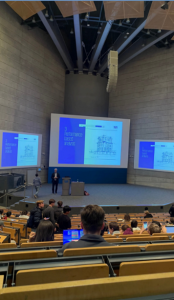
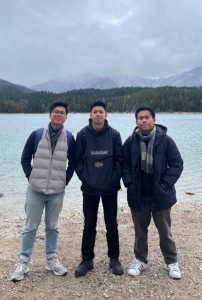
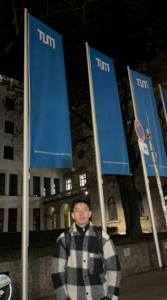
Technische Universität München (TUM)
Academic Information
University: Technical University of Munich
School: School of Engineering and Design
Program: Geodesy & Geoinformation
Credits Earned: 30 ECTS (equivalent to ~18–20 SKS)
Sample Courses Taken
- Satellite Altimetry and Physical Oceanography
- Integrated Land and Water Management
- Hydrogeodesy: Monitoring Surface Waters from Space
- Advanced GIS for Environmental Engineering – Theory
- Entrepreneurship
- Financial Accounting
Social and Cultural Experience
1) Language & Daily Life
- English is widely used in graduate-level lectures, but basic German is helpful for daily interactions.
- Locals may seem reserved at first, but they are generally polite and helpful.
- Munich is highly international; English works well in most urban areas.
- Punctuality (Pünktlichkeit) is a key cultural value; public transport and personal appointments are strictly on time.
2) Food, Living, and Cost of Life
Munich is known for its high living costs, especially accommodation. However, students benefit from:
- Mensa (University Canteen): Affordable meals (€4–€5) with large portions.
- Halal Options: Many Döner Kebab shops serve halal food.
- Asian Markets: Easy access to Asian ingredients for cooking Indonesian food.
3) Friends, Community, and Travel
- Munich’s strategic location allows easy weekend trips to Austria (Salzburg), Switzerland, or northern Italy.
- Student activities such as TUM SOM Student Council events provide opportunities to meet peers from Europe, Asia, and Latin America.
- The multicultural environment encourages global networking and broadens perspectives.
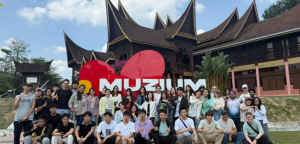
Universiti Teknologi Malaysia (UTM)
Academic Information
Faculty: Faculty of Built Environment and Surveying
Program: Geomatics Engineering
Credits Earned: 15 SKS
Sample Courses Taken
- Industrial Survey
- Terrestrial Laser Scanning (TLS)
- Tidal Processing and Analysis
- Digital Photogrammetry
- Satellite Positioning II
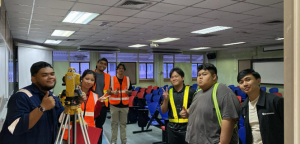
These technical subjects offer exposure to field instruments, modern surveying techniques, and advanced data processing.
Social and Cultural Experience
1) Language and Communication
Malay is the primary language used in Malaysia, which makes communication easier for Indonesian students. Adapting to local language and daily interactions is relatively seamless.
2) Food and Cost of Living
Malaysian cuisine is similar to Indonesian food, with additional Chinese and Indian influences. Food is affordable:
- Canteen (near dormitory): RM 4.5 (~Rp 18,000)
- Most restaurants: RM 8–15 (Rp 32,000–60,000)
3) Student Community and Activities
- Student life at UTM is enjoyable and welcoming.
- Lecturers and peers show curiosity and interest toward Indonesian students.
- The pre-university system means many local students are older.
- Exchange students may feel the youngest despite taking third-year subjects.
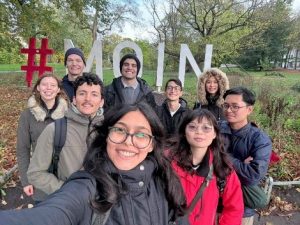
Technische Universität Hamburg (TUHH)
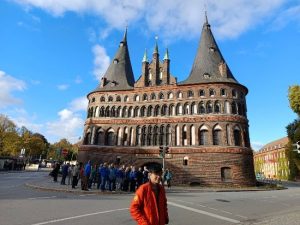
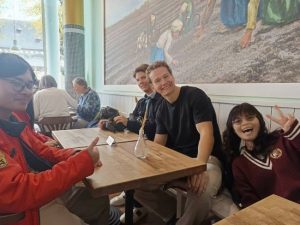
Academic Information
Faculty: Civil Engineering
School: Geo-Hydroinformatics
Credits Earned: 25 ECTS (~17–18 SKS)
Sample Courses Taken
- Emerging Trends in Environmental Engineering
- Introduction to Climate-Informed Engineering (GNSS & Remote Sensing Applications)
- Geo-Information Systems in Water Management
- Advanced Topics in Management and Human Resource Management
- Chinese I1
- German A1.1
Social and Cultural Experience
1) Language and Communication
Daily communication still relies heavily on German, though locals are willing to switch to English when needed.
2) Social Interaction and Local Culture
- Germans may appear serious but are polite and open once approached respectfully.
- Timing matters in social interactions.
- Germans value structure yet remain friendly and open-minded.
3) Muslim-Friendly and Indonesian Community
- Halal restaurants widely available
- Turkish/Arab grocery stores
- Indonesian products near Hamburg Hauptbahnhof
- No discrimination against Muslims
4) Cost of Living
- Groceries: €10–€30 (if cooking at home)
- Halal restaurants: €4–€10
- Mensa: €2–€5
5) Networking and Community Activities
- ESN connects students with HAW Hamburg, UHH, HFBK Hamburg
- Regular international events build global networks
Handbook & Flyer

Handbook of the International Undergraduate Program
Detailed academic structure, curriculum, exchange information, and program regulations are available in the official handbook.
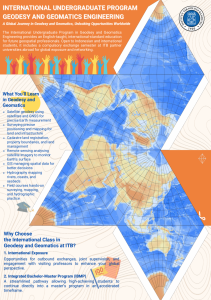
Flyer of the International Undergraduate Program
A concise overview of the International Undergraduate Program, including key highlights and academic opportunities.
Hits: 51

