
Introducing The Sangkuriang Python Package for Ocean Wave Modeling
[ENGLISH VERSION]
Introducing The Sangkuriang Python Package for Ocean Wave Modeling
Oleh: Dasapta Erwin Irawan (Feature chat with our paper di Google NotebookLM)
We just publisehd a paper in Water (2026) recently, titled “An Open-Source Pseudo-Spectral Solver for Idealized Korteweg–de Vries Soliton Simulations”. At Institut Teknologi Bandung, colleagues from Applied Geology, Atmospheric Science, and Geodesy and Geomatics combined strengths, and the work gained an extra layer of perspective through collaboration with a PhD student in the Indonesian academic diaspora at the School of Systems Science and Industrial Engineering, State University of New York.
What they chose to build was not a one off model, but a piece of open source infrastructure. The aim is practical. Provide a way to simulate ocean wave dynamics, then use those simulations to ask better questions about what waves can do in Indonesian coastal waters.
Application for the seawater and freshwater interface
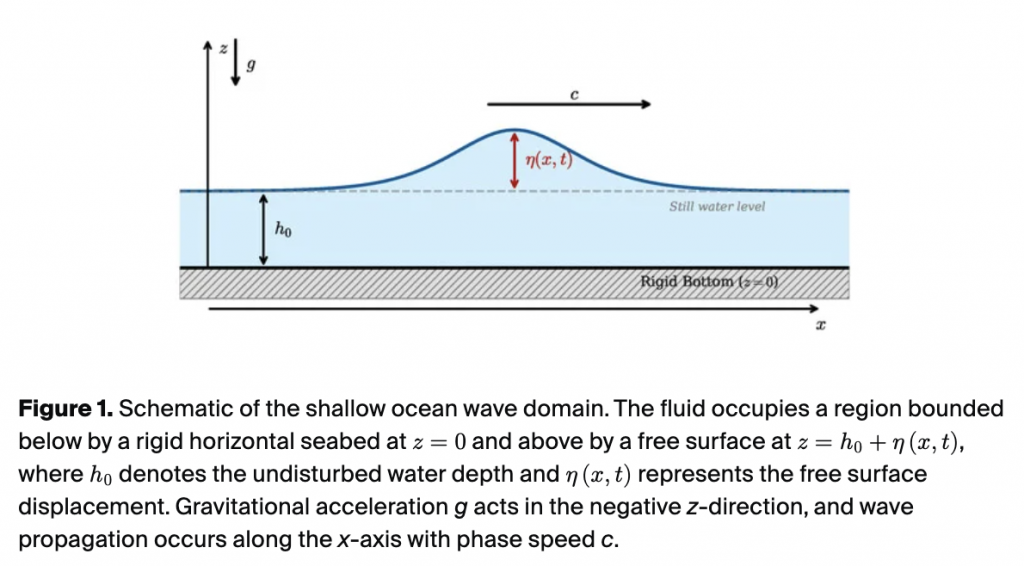
For people who work at the meeting point of oceanography and coastal hydrogeology, the paper offers a clear bridge between wave physics and groundwater relevance. The central character is the soliton, a wave that can travel far while holding its shape in a layered ocean.
In a coastal setting, that matters in at least three connected ways.
- Pressure and mixingInternal solitary waves can drive turbulent mixing and shift pressure on the seafloor. That means a coastal story told only from tides and currents can miss an important part of the energy budget.
- Indirect effects on coastal groundwater systemsThose pressure changes and energy transfers can also influence the seawater and freshwater boundary. In practice, this is part of the wider set of processes that shape seawater intrusion and the dynamics of coastal aquifers.
- Indonesia as an island nationIn places such as the North Natuna Sea and the Sulu Sea, internal waves can be strong enough that a lightweight prediction tool becomes valuable for early exploration and for testing parameter scenarios before moving to heavier models.
Efficiency on standard hardware
The team’s Python library is called sangkuriang. It is built with a simple promise. It should run on ordinary machines, not only on supercomputers. With Numba just in time (JIT) optimization, simulations that once required long runtimes become feasible on a standard laptop. This matters for widening participation and for keeping computational work within reach of more researchers in Indonesia.
Limits and future challenges
The authors also keep expectations grounded. This is still an early and highly idealized model, and it carries clear boundaries.
- Constant coefficient equationsThe solver assumes a uniform ocean environment, while real waters shift in stratification and properties over space and time.
- No bathymetryThe current setup assumes a flat seafloor, so it cannot yet represent slopes and complex underwater topography that shape many Indonesian settings.
- Periodic boundary conditionsThe model treats waves as if they repeat in a loop, which limits realism when waves meet coastlines or river mouths.
- Rotation effectsEarth rotation and the Coriolis effect are not included yet, even though they can matter at larger scales.
Conclusion
Taken as a whole, this work reads as a modest but meaningful investment in independent computational capacity. Through sangkuriang, the authors point to a future where coastal complexity can be explored with tools that are free, open, and shaped by local research needs.
The sangkuriang library (v0.0.10) is available on GitHub. It can be installed through PyPI. Examples can be found in this related GitHub repository at suppl_sangkuriang.
Hits: 3


No Comments